How to write a Facebook Marketplace description: what goes in the first lines
Par Oleksandr Shaniuk · fondateur de Sellura · Mis à jour le 24 octobre 2026
Write a Facebook Marketplace description in this order: what the item is in plain words, its condition with any flaws, its size or measurements, what is included, and whether it is pickup only or can ship. Meta's help on selling asks for a detailed description of the item and its condition, and to describe any stains or tears. It publishes no length for a personal listing, and Facebook's listing form showed none either: it took 100,000 characters without a warning when we tried on 24 October 2026.
- Description limit in Facebook's form
- None found
- 100,000 characters accepted, 24 Oct 2026
- Shown on partner-feed listings
- 256 chars
- Meta's partner docs, Europe only
- Title cap in Facebook's form
- 99 chars
- read in a form outside the US
- Photos per listing
- Up to 10
- Facebook's listing form
So length is not the limit, the start is. It is what a buyer reads before deciding to message you, and for listings that business partners send to Marketplace in Europe, Meta's developer documentation says only the first 256 characters show. Paste your listing into the box below for a score on the title and description, then work down the sections.
Check your own listing
Already listed on Facebook Marketplace? Score your listing
Copy the title and description from your Facebook Marketplace listing and paste them here for a 0–100 score and the top fixes, then rewrite it with your own words already filled in.
Free, no sign-up.
The order: what a buyer needs before they message you
A Marketplace buyer who opens your listing has one question first: is this the thing I searched for, and is it in the shape I want? Every line that answers a question they would otherwise send you saves a message, and a buyer with no questions left is a buyer who asks when to collect. Meta's help asks for the same two things at the top: a detailed description of the item, and its condition.
Five lines, in this order, cover what most buyers ask. Each is one or two plain sentences, not a paragraph, and none of them is about you or about the deal.
- What it is: the item, its brand and its model in plain words, the same words that are in the title.
- Condition and flaws: how it has been used, and each stain, tear, chip or scratch, with where it is.
- Size: measurements for furniture and anything that has to fit somewhere, the label size for clothes.
- What's included: the parts, the charger, the manual, the box, or that something is missing.
- Pickup or shipping: pickup only, or that it can ship, and anything a buyer needs to plan, such as it being heavy.
Score your listing's title and description, free →
Source: Facebook Help Center: Selling on Marketplace (a detailed description of the item and its condition, stains and tears, original photos), checked 24 October 2026
Why the first lines carry the description
Meta publishes no description length for a personal listing, and the form gave us none to find: a 100,000-character description went in without a warning on 24 October 2026. A seller who writes long loses nothing to a limit. What they lose is the buyer who reads two lines, finds no condition and no size, and moves on to the next listing nearer home.
Meta draws that line itself in one place. For listings that business partners send to Marketplace through its feed in Europe, the developer documentation allows a description of up to 9,999 characters and says only the first 256 show on the listing. That rule is not about a personal listing in the US, but it is where Meta separates the part people see from the rest. Sellura writes the searched words into the first 150 characters and keeps the whole description inside 2,000, both numbers ours.
Sources: Facebook's "Item for sale" listing form (no description limit shown, 100,000 characters accepted, title stops at 99, Product tags "Limit: 20", up to 10 photos), checked 24 October 2026 · Meta for Developers: Marketplace partner Item API (description up to 9,999, only the first 256 characters shown on the listing, for partner feeds in Europe), checked 24 October 2026
Condition and flaws: say them before the buyer asks
Meta's help asks sellers to describe the item's condition and any stains or tears, and its Commerce Policies rule out misleading offers. A flaw a buyer finds at your door is a sale that falls through after a drive, so name each one, say where it is, and show it in a photo. "One 1-inch scratch on the top, shown in photo 4" ends the conversation that "good condition" starts.
Use the condition the form gives you, and make the words agree with it. A listing marked as like new whose description mentions a cracked leg reads as a seller hiding something, even when the leg is the only flaw.
Watch outA hidden flaw is a misleading offer
Meta's Commerce Policies rule out misleading offers. A description that leaves out a known flaw promises the buyer something the item can't deliver.
Messages but no sale? Where Marketplace buyers drop off →
Sources: Facebook Help Center: Selling on Marketplace (a detailed description of the item and its condition, stains and tears, original photos), checked 24 October 2026 · Meta Commerce Policies (a product for sale, and no services, jobs, digital products, subscriptions, counterfeits or misleading offers), checked 24 October 2026
The words buyers search for: in the title first, then once in the description
Meta's help on finding items says a buyer types into the Marketplace search box or browses a category, then sorts by Suggested, Distance or Date listed. The title carries the search: item, brand, model, size and colour, each once. Facebook's form stops it at 99 characters, read in an account outside the US, so the US form may differ. We aim at about 65, our number, borrowed from Meta's advice for catalog titles.
The description says what the item is in plain words once, near the top, and from there it answers the buyer, not the search box. A list of keywords at the bottom helps nobody who reads it. Words a buyer might type that the title had no room for go into the optional Product tags field, where the form prints "Limit: 20". We write 10 tags of up to 30 characters, both numbers ours.
Check a title against the 99 characters Facebook's form takes → · Product tag ideas for Facebook Marketplace →
Sources: Facebook Help Center: Sort by distance or new listings on Marketplace (search, browse by category, sort by Suggested, Distance or Date listed), checked 24 October 2026 · Facebook's "Item for sale" listing form (no description limit shown, 100,000 characters accepted, title stops at 99, Product tags "Limit: 20", up to 10 photos), checked 24 October 2026
What Meta's rules keep out of a description
Meta's Commerce Policies apply to every Marketplace listing, and a few of them decide what a description may say. A listing that breaks one can be rejected, which costs more than a slow sale.
- A listing has to offer a product for sale. A wanted post or a listing that only points somewhere else is out.
- No services, jobs, digital products or subscriptions: a Marketplace listing is a physical item.
- No counterfeits, and no brand the item isn't. Name the real brand, or none.
- No misleading offers: the condition, the size and what is included have to be true.
- Our advice, not a policy for personal listings: leave phone numbers and links out, since buyers message you on Facebook. Meta's rules for catalog products say the same about links.
Sources: Meta Commerce Policies (a product for sale, and no services, jobs, digital products, subscriptions, counterfeits or misleading offers), checked 24 October 2026 · Meta Business Help Center: catalog product fields (description up to 9,999, plain text, no links, for catalog products, not personal listings), checked 24 October 2026
A template to copy
Fill each line with your item's facts and delete the lines that don't apply. Keep each to a sentence or two: the template is short on purpose, because the buyer reads it on a phone.
| Line | What to write | Example |
|---|---|---|
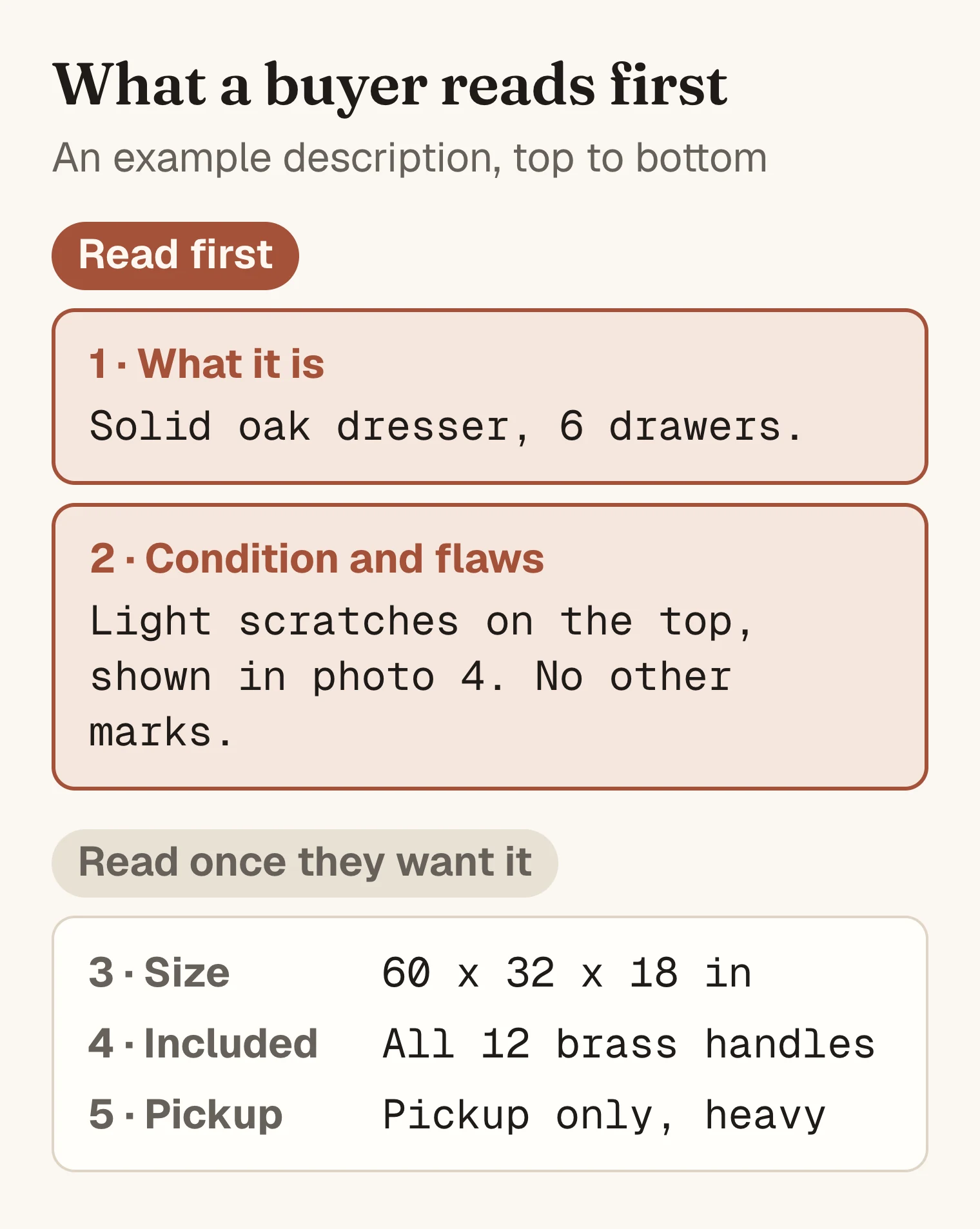
| 1. What it is | What to writeItem, brand and model, the title's words | ExampleSolid oak dresser, 6 drawers. |
| 2. Condition | What to writeHow used, and each flaw with where it is | ExampleGood condition. One 1-inch scratch on the top, shown in photo 4. |
| 3. Size | What to writeMeasurements, or the label size | Example59 in wide, 18 in deep, 31 in tall. |
| 4. Included | What to writeParts, accessories, or what is missing | ExampleOriginal brass handles, all 12. |
| 5. Handover | What to writePickup only or ships, and what to plan | ExamplePickup only. Heavy, bring a helper. |
Our template, not a Meta format. The order follows Meta's request for a detailed description of the item and its condition.
What Sellura wrote for one item
On 24 October 2026 we asked Sellura for a Facebook Marketplace listing of one item, described in a few words: a solid oak 6-drawer dresser, 60 x 32 x 18 inches, with light scratches on the top. The title and the opening of the description below are exactly what it returned, on a test deployment of the site.
The item, its material and its size are in the title, and the scratches the seller named are stated, not hidden. Nothing about price, location, pickup or delivery was added: those are the seller's to set in Facebook's own fields. One thing falls short of this guide's own advice: the condition line comes in the fourth paragraph, not in the first two lines. Move it up before you paste the description in, and cut any line about retail prices you can't show.
| Field | What Sellura returned | Length |
|---|---|---|
| Title | What Sellura returnedSolid Oak 6-Drawer Dresser – real wood bedroom storage, 60x32x18 in | Length67 of 99 |
| Description, first lines | What Sellura returnedSolid oak 6-drawer dresser — genuine hardwood built to last, offering generous bedroom storage with a timeless look that fits any family home. | Length142 (977 in all, budget 2,000) |
| Product tags | What Sellura returnedsolid oak dresser, 6 drawer dresser, real wood dresser, bedroom dresser storage, oak wood furniture (5 of 10) | Length10 tags, 16 to 25 characters |
| Score | What Sellura returned100 | Length0–100 |
Generated by Sellura on 24 October 2026 on a test deployment. Lengths counted in characters.
What Sellura does here, and what it doesn't
Describe the item in a few words or a photo and Sellura writes the two pieces of text a Marketplace buyer reads. A title of about 65 characters, inside the 99 Facebook's form takes, item and brand first. A plain-text description inside 2,000 characters that opens with what the item is, then condition and flaws, size and what is included, and 10 product tags for the optional field. Each generation comes with a 0–100 score that is deterministic: the same listing always gets the same number, and each weak factor comes with one fix written for that listing.
The score and the title preview are free on every generation, with no card, and so are the Listing checker for pasted text, the title checker and the Facebook Marketplace fee calculator. A credit unlocks one finished listing: Starter is $15 a month for 25 credits or $150 a year, and Pro is $24 a month for 65 credits plus bulk, or $240 a year. Sellura doesn't post to Facebook, read Marketplace search or track where a listing shows, and it has no research database or ads analysis.
Write the Facebook Marketplace listing, score and title free → · Plans and credits →
FAQ
How long can a Facebook Marketplace description be?
What should I put in a Facebook Marketplace description?
Should I put keywords in my Facebook Marketplace description?
Can I put my phone number or a link in a Marketplace description?
Does Facebook Marketplace show the whole description?
Open the description with what the item is, in the words of the title, then its condition and every flaw with where it is, its size, what is included, and pickup or shipping. Keep each line short, keep phone numbers and links out, and make sure nothing in it contradicts the condition you picked in the form. Then put the searched words in the title, inside the 99 characters Facebook's form takes, and the rest in the optional tags. To redo the text, paste your title and description into the box above, or describe the item to Sellura: the title preview and the 0–100 score are free, and a credit buys the finished listing.
Ouvre le générateur pour Facebook Marketplace.