How to get sales on Folksy: get found in its search, then bring buyers in
Par Oleksandr Shaniuk · fondateur de Sellura · Mis à jour le 1 novembre 2026
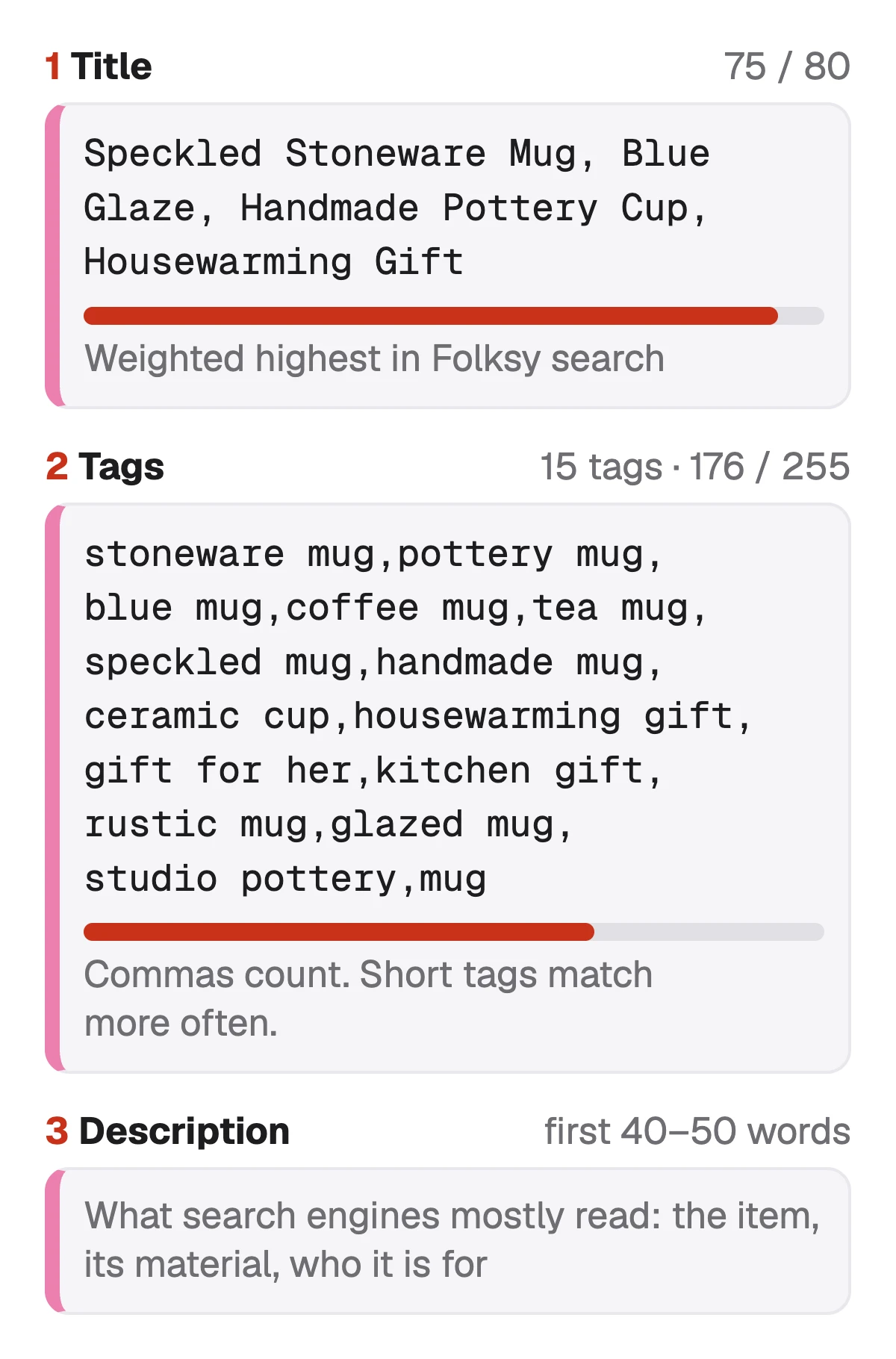
To get sales on Folksy, fix the listing before you promote it. Folksy's help says the title carries the most weight in its search, so make it a complete description with the most important words first. Give it 15 short tags inside Folksy's 255-character total, and open the description with 40 to 50 words that say plainly what the item is, because that is what search engines mostly read (Folksy seller help, read 1 November 2026). Then bring buyers in: Folksy's own advice is social media and its seller forums.
- Title
- 80 characters
- weighted highest in Folksy search
- Tags
- 15 in 255
- characters in all, commas included
- First listings
- 3 free
- then 15p + VAT per unit listed
- A listing lasts
- about 120 days
- relist up to once a day
Folksy publishes nothing on how relisting or a new listing ranks, and its sellers disagree about it, so this guide doesn't sell a ranking trick. Below: each listing field in the order Folksy weights it, what a slow start costs you, and where to send buyers from.
Check your own listing
Already listed on Folksy? Score your listing
Copy the title and description from your Folksy listing and paste them here for a 0–100 score and the top fixes, then rewrite it with your own words already filled in.
Free, no sign-up.
Found, chosen, bought: where a Folksy sale stalls
A sale on Folksy needs three things to go right. A shopper has to find the item, in Folksy's search or on Google. They have to choose it over the next one, which is mostly the photo and the price. And they have to buy, which needs the description to answer what they want to know: what it is made of, how big it is, who it suits.
Fix them in that order. The first step is also the cheapest: a short title, a few long tags or a description that opens with the maker's story rather than the item all cost nothing to change.
| Stage | What decides it | Fix first |
|---|---|---|
| Found | What decides itTitle, tags, the first 40 to 50 words | Fix firstA complete 80-character title, 15 short tags |
| Chosen | What decides itThe first photo, the price with postage | Fix firstA square, sharp main image of the whole item |
| Bought | What decides itMaterials, size, who it suits | Fix firstMaterials and dimensions in the description |
Our order of work. What each field does is from Folksy's seller help, read 1 November 2026.
The title: complete, most important words first
Folksy's help says the title has the highest weighting in its search results and asks you to make it as complete as possible, up to 80 characters, with the most important words at the beginning. It lists what belongs there: what the item is, its colours and materials, its style or pattern, and the occasion or person it would suit as a gift.
So a short, tidy title that does well elsewhere is leaving Folksy's strongest field half empty. Use the 80 characters on words a shopper would type, each once, rather than on the shop name or on adjectives like "lovely".
- What it is first: "Speckled Stoneware Mug", not "Handmade by me".
- Then colour and material: "Blue Glaze", "Sterling Silver".
- Then style or pattern: "Geometric", "Minimalist".
- Then the occasion or recipient, when it fits: "Housewarming Gift".
- No "/": Folksy's listing form refuses it in a title (read in the form's code, 25 October 2026). And no rude words anywhere in the listing.
Check a title against Folksy's 80 characters, free → · Folksy SEO: the title, the 15 tags and the first 50 words →
Source: Folksy help: Titles and description (titles up to 80 characters, the highest weighting in search, most important words first, colours, materials, style, occasion or recipient), checked 1 November 2026
The first 40 to 50 words: written for Google as well as Folksy
Folksy calls the opening of the description the power paragraph: search engines mostly read its first 40 to 50 words, so that is where the item, its material and who it is for belong, in sentences that read naturally. Its help warns that a string of keywords there can get a listing penalised, and that word variations such as "bag" and "handbag" help where repeats don't.
After that come how and where it was made, the materials and the dimensions, and the occasions it suits, inside 1,500 characters. Write it fresh for Folksy: its help says a description copied from another site works against you in Google and Bing.
Watch outDon't paste your Etsy description
Folksy asks for content unique to Folksy and says duplicate descriptions harm a listing in Google and Bing. Rewrite at least the first 40 to 50 words.
Folksy vs Etsy: why one listing can't serve both →
Source: Folksy help: Titles and description (descriptions up to 1,500 characters, the power paragraph, the first 40 to 50 words, no keyword strings, no copied descriptions), checked 1 November 2026
Photos: a square main image, 1,000 pixels or more
Once a shopper finds the listing, the main photo decides whether they open it. Folksy asks for a square main image of at least 1,000 × 1,000 pixels, showing the whole product, in focus, lit by daylight rather than flash. Square images, it says, are also the ones it can share on its social channels and in its newsletter.
A Basic shop gets up to 5 images per listing and a Folksy Plus shop up to 10. Use them: the item from the front, from the side, a close-up of the detail or the maker's mark, and the item in use, so its size is obvious without reading.
Product photos on a clean background, square for Folksy →
Source: Folksy help: Photos, sizing and uploading (up to 5 images, 10 on Folksy Plus, a square main image of at least 1000 × 1000 px, in focus, daylight, files over 5MB may fail), checked 1 November 2026
Bring buyers in: what Folksy tells its sellers
Folksy's help says success depends on getting your products in front of the right customers, and its advice is about what you can do yourself. It suggests working out who your buyers are, then marketing where they spend time, with social networks as the most cost-effective place to start: a Facebook business page, a blog, other social accounts. It also points new sellers to its forums to learn what has worked for others.
Promotion has one rule attached. You may sell elsewhere, but a Folksy listing can't send buyers to another site to buy, so your social posts link to the Folksy listing, never the other way round.
- Decide who buys what you make, and post where those people already are.
- Share the listing's own Folksy link from social media; square photos travel best there.
- Join Folksy's seller forums: other sellers' threads on promotion are where Folksy's help sends you.
- Keep your Etsy shop, website and social handles out of the Folksy listing text.
Sources: Folksy help: How can I promote my shop to get more sales? (know your target market, social networking, a Facebook business page, the Folksy forums), checked 1 November 2026 · Folksy help: Policy on listing items for sale (you may sell elsewhere, but not direct buyers to another site to complete a purchase), checked 1 November 2026
What a slow start costs, and what relisting does
Waiting for a first sale is cheap on Folksy. Your first 3 listings are free; after that a Basic shop pays 15p + VAT for each unit it lists, and a listing lasts about 120 days or until it sells out. You can relist before then, up to once a day. On Basic each relist is charged again; on Folksy Plus, at £7.50 a month or £75 a year, listing and relisting are free. Commission is 6% + VAT of the item price on either plan, never the postage.
Whether relisting lifts an item in Folksy's search, Folksy doesn't say anywhere in its help, and sellers in its forums report both answers. Treat a relist as a way to keep a listing live, not as a ranking fix, and spend the effort on the title and tags first.
| Basic | Folksy Plus | |
|---|---|---|
| Subscription | BasicNone | Folksy Plus£7.50 a month or £75 a year |
| First listings | Basic3 free | Folksy PlusUnlimited |
| Listing fee | Basic15p + VAT per unit | Folksy PlusFree |
| Relisting (up to once a day) | Basic15p + VAT per unit again | Folksy PlusFree |
| Commission | Basic6% + VAT of the item price | Folksy Plus6% + VAT of the item price |
Folksy's help, read 1 November 2026. Payment processing is Stripe's or PayPal's, on top.
Folksy fee calculator: what you keep on Basic or Plus →
Source: Folksy help: How much does it cost to sell on Folksy? (first 3 listings free, £0.15 + VAT per item quantity, about 120 days, relist up to once a day, Plus £7.50 a month or £75 a year with free listing and relisting, 6% + VAT commission not charged on postage), checked 1 November 2026
What Sellura does here, and what it doesn't
Sellura writes a Folksy listing from one description of your item: a title of about 75 characters inside the 80, with no slash, the item first and the occasion when your details support one; 13 lowercase tags of up to 18 characters, so the whole set always fits Folksy's 255 (our numbers); up to 5 materials; and a description inside 1,500 characters that opens with the power paragraph, in British English. It never adds a material, a measurement or a making claim you didn't give it.
Free, no card: the title preview and a 0 to 100 score on every generation (15 before we ask you to make an account), the Folksy fee calculator, the title checker, and 2 Listing Grader checks on a pasted title and description. The score is deterministic: the same listing always gets the same number, and each weak factor comes with one fix. A credit unlocks one finished listing with every field. Starter is $15 a month for 25 credits or $150 a year; Pro is $24 a month for 65 credits plus bulk, or $240 a year.
- It doesn't post, relist or promote on Folksy, and it can't see your shop's views or sales.
- It doesn't decide whether your item qualifies for Folksy: Folksy's rules do.
- It has no keyword-volume database, no rank tracking and no ads analysis, and it is not affiliated with Folksy.
Describe your item, see the Folksy title and score free → · Plans and credits →
FAQ
How do I get more sales on Folksy?
Why am I not getting sales on Folksy?
Does relisting on Folksy help sales?
How many tags can I use on Folksy?
How long does it take to get a first sale on Folksy?
Is it worth selling on Folksy?
Before you promote anything, rewrite the three fields Folksy's search and Google read: a complete title of up to 80 characters with the item first and the occasion last, 15 short tags that fit 255 characters, and a first 40 to 50 words that say what the item is, what it's made of and who it's for. Add a square main photo of at least 1,000 pixels. Then share the Folksy listing where your buyers spend time, and don't count on relisting to lift it. Describe the item once to see the Folksy title and its score free before you spend a credit.
Ouvre le générateur pour Folksy.