Alibaba Product Keywords: how to choose the three that get your product found
Von Oleksandr Shaniuk · Gründer von Sellura · Aktualisiert 24. Oktober 2026
Alibaba.com gives each product exactly three Product Keywords, all of equal priority, so choose three different phrases a buyer would type to find it: the product's common name, the other name buyers use for it, and the name plus the specification or use they filter by. Keep commas and semicolons out of each keyword, never repeat one, and make sure all three agree with the product name. Those rules come from Alibaba.com's own supplier training and its listing API, read on 22 and 24 October 2026.
- Product Keywords per product
- 3
- all of equal priority
- Per keyword: no comma or semicolon
- 1 phrase
- Alibaba.com's listing API
- Product name, characters
- Up to 128
- Alibaba.com's 2026 seller guide and API
- Description, characters
- Up to 50,000
- HTML allowed, current listing API
The three keywords sit next to two other fields Alibaba.com search reads: the product name, which takes up to 128 characters, and the attributes. Below: what each keyword slot is for, where Alibaba.com itself shows the phrases buyers search, the mistakes that waste a slot, and what to read when a product gets views but no inquiries. Paste your product name and description into the box below for a score first.
Check your own listing
Already listed on Alibaba.com? Score your product
Copy the product name and description from your Alibaba.com listing and paste them here for a 0–100 score and the top fixes, then rewrite it with your own words already filled in.
Free, no sign-up.
What the three Product Keywords are
Alibaba.com's supplier training defines a product keyword as the word or phrase buyers use to find your product in its search engine. It says you can set 3 keywords in total, that all three carry equal priority, and that they should not conflict with the product name. The older listing API says the same in its own words: at most three keywords, with no comma or semicolon inside one.
How long one keyword can be depends on which form of the field you read. The older API takes 1 to 256 characters per keyword; the current listing API takes all three as one line of up to 384 characters, separated by spaces. Neither is a length to aim for. We keep each keyword to 60 characters, which is our own budget, not Alibaba.com's: a buyer's search phrase is a few words, not a sentence.
- Three slots, equal weight: no keyword counts more for coming first.
- Each keyword is one phrase. A comma or a semicolon inside it is refused by the older API, so a list does not fit in one slot.
- The keywords and the product name describe the same product in the same words.
- Three different phrases. Alibaba.com's training says plainly not to repeat keywords.
Sources: Alibaba.com supplier training: Product Keywords (3 in total, equal priority, no conflict with the product name), checked 24 October 2026 · Alibaba.com Open Platform (older API): alibaba.icbu.product.add (at most 3 keywords, 1–256 characters, no , or ;), checked 22 October 2026 · Alibaba.com Open Platform: Create a new product listing (keywords line, 384 characters), checked 22 October 2026
How to fill the three slots
Alibaba.com's training asks for popular terms buyers really search, and for the aliases buyers use for the same product. Its 2026 seller guide adds that the best keywords are the ones closest to what the product is, since those can also go into the product name, and that a keyword is worth more where search popularity is high and the number of suppliers using it is low.
So give each slot a different job. The table is our method for doing that, not a rule Alibaba.com publishes, shown on a 500 ml stainless steel vacuum flask. Three spellings of one phrase would fill all three slots and reach one search.
| Slot | What goes in it | Example |
|---|---|---|
| 1 | What goes in itThe product's common name, as most buyers type it | Examplevacuum flask |
| 2 | What goes in itThe other name buyers use for the same product | Exampleinsulated water bottle |
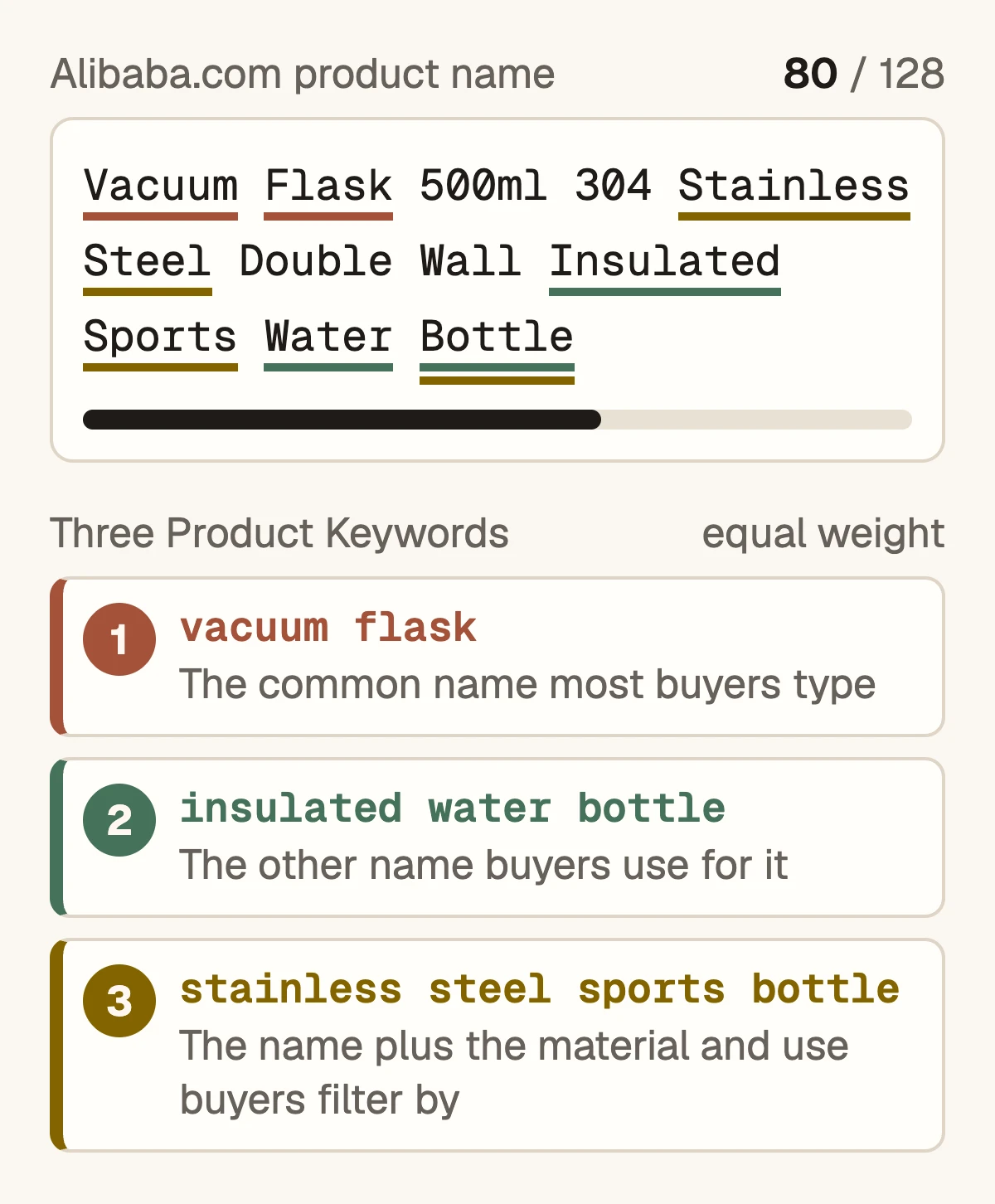
| 3 | What goes in itThe name plus the material, size or use buyers filter by | Examplestainless steel sports bottle |
Our method, not an Alibaba.com rule. The advice it rests on (popular terms, aliases, keywords close to the product) is Alibaba.com's supplier training and its 2026 seller guide, read 24 October 2026.
Get three Alibaba.com keyword ideas from the free tag generator →
Sources: Alibaba.com supplier training: Product Keywords (popular terms, aliases), checked 24 October 2026 · Alibaba.com seller guide: product listing optimization, July 2026 update (choosing keywords), checked 24 October 2026
Where Alibaba.com shows the phrases buyers search
You don't have to guess the phrases. Alibaba.com puts several of its own keyword suggestions in front of suppliers, and they are the best evidence of what its buyers type, because they come from its own search. The supplier training is from around 2016, so a menu may have moved since; the Keywords Trends page was read on 24 October 2026.
- In the Product Keywords field itself: Popular Search Keywords and Smart Keywords. The training describes Smart Keywords as terms buyers use often and suppliers rarely.
- In the search bar on the Alibaba.com home page: the Related Search suggestions under a phrase you type.
- Keywords Trends on seller.alibaba.com: keywords trending over 7 or 30 days, what buyers search before and after a keyword, synonyms, and the countries the buyers are in.
- After listing, the training points to Keyword Optimization under Products, then Listings Optimization Tools, to see how each keyword performs.
Sources: Alibaba.com supplier training: Product Keywords (Popular Search Keywords, Smart Keywords, Related Search, Keyword Optimization), checked 24 October 2026 · Alibaba.com: Keywords Trends, checked 24 October 2026
The product name has to agree with the keywords
The product name is what buyers see in search results, and it can be up to 128 characters, a cap stated in Alibaba.com's 2026 seller guide and in both of its listing APIs. The guide adds that a shorter name is usually more precise, while a longer one covers more keywords but can weaken relevance. Alibaba.com recommends no length of its own; we aim at about 100 characters, which is our target, not its rule.
Alibaba.com's training on the product name asks for the core product word, the product before its function ("Mobile Phone-MP3 function", not the other way round), and the features buyers search. The flask, written that way, is "Vacuum Flask 500ml 304 Stainless Steel Double Wall Insulated Sports Water Bottle": 80 characters, and every one of the three keywords is in it.
- Avoid special characters such as + \ and quotation marks: write "inch", not the symbol.
- Don't repeat a keyword inside the name.
- Never use only a brand name or a model number as the product name.
- Give similar products different names rather than one name for all of them.
- No keyword lists and no prohibited terms, Alibaba.com's 2026 guide says. Its listing API rejects a prohibited word with an error, but the list itself is not published.
Check a product name against Alibaba.com's 128 characters → · Alibaba SEO: the product name, the keywords and the attributes →
Sources: Alibaba.com seller guide: product listing optimization, July 2026 update (128 characters, length and relevance, keyword lists, prohibited terms), checked 24 October 2026 · Alibaba.com supplier training: Product Name (core product word, special characters, repetition, brand or model only), checked 24 October 2026 · Alibaba.com Open Platform: Create a new product listing (product name, 128 characters), checked 22 October 2026 · Alibaba.com Open Platform (older API): alibaba.icbu.product.add (name at most 128 characters, prohibited-word error), checked 22 October 2026
Five ways to waste a keyword slot
Each of these leaves the product with fewer than three chances to be found, and most come from treating the field like a box of tags on a consumer marketplace.
- Three spellings of one phrase ("vacuum flask", "vacuum flasks", "flask vacuum"): one search, three slots.
- A list inside one slot ("flask, bottle, tumbler"): the older API refuses the comma, and the slot was meant for one phrase.
- A brand or a model number alone: Alibaba.com's training says a name should never be only that, and a keyword only the supplier knows reaches only buyers who already know it.
- A keyword the product isn't, to reach a bigger search: the training says keywords should not conflict with the product name, and buyers who land on the wrong product leave.
- A phrase that is in no other field: if the keyword is nowhere in the name, the attributes or the description, nothing on the page backs it up.
Watch outCategory and attributes count too
Alibaba.com's 2026 seller guide says complete and accurate attributes help its system match a product to the right searches, and that a product whose main image, title or description does not match its category is miscategorized. Three good keywords don't rescue a product in the wrong category.
Sources: Alibaba.com supplier training: Product Keywords (no repetition, no conflict with the product name), checked 24 October 2026 · Alibaba.com seller guide: product listing optimization, July 2026 update (category and attributes), checked 24 October 2026
Views but no inquiries: what to read first
On Alibaba.com the sale starts with an inquiry, so the question is where buyers stop. Alibaba.com's 2026 seller guide tells suppliers to update the title from its impressions and click-through rate, to test several versions and keep the best, and not to change sharply a title that already works. That works for the keywords too: change one at a time, and give it time before you judge it.
The keywords only decide whether a product is found. Once a buyer has clicked, they are comparing suppliers, and what they compare is mostly what the supplier alone can set: the minimum order, the price tiers, the lead time and the certifications. A product found and clicked but never asked about usually has a gap there, not in its keywords.
| What you see | What it usually means | Check first |
|---|---|---|
| Few impressions | What it usually meansBuyers' searches aren't reaching it | Check firstThe three keywords, the category, the attributes |
| Impressions, few clicks | What it usually meansFound, but the result doesn't earn the click | Check firstThe product name, then the main image |
| Clicks, no inquiries | What it usually meansOpened, but the offer doesn't answer the buyer | Check firstSpecifications in the description, then your minimum order, price tiers and lead time |
| Inquiries from the wrong buyers | What it usually meansA keyword is too broad or off the product | Check firstThe keyword that brings them: make it the product's own phrase |
Our reading of the signals, not an Alibaba.com rule. Updating titles from impressions and click-through rate is Alibaba.com's 2026 seller guide, read 24 October 2026.
Source: Alibaba.com seller guide: product listing optimization, July 2026 update (testing and updating titles), checked 24 October 2026
What the attributes and the description carry
A business buyer filters and compares on specifications, so whatever the three keywords and the name can't hold goes into the attributes and the description. The current listing API takes each attribute value up to 50 characters, a description up to 50,000 characters with HTML allowed, and up to 6 images.
Write the attributes as the facts a buyer compares: material, size or capacity, colour, power, the standard it meets. Open the description with what the product is and what it is used for, then the full specifications. Use the keywords' words where they are true, never as a list.
Alibaba product description: the 7–8 modules buyers read →
Source: Alibaba.com Open Platform: Create a new product listing (attribute value 50, description 50,000 with HTML, 6 images), checked 22 October 2026
What Sellura does here, and what it doesn't
Describe the product once, in a few words or with a photo, and Sellura returns an Alibaba.com product name inside 128 characters, three Product Keywords that are three different phrases with no commas or semicolons, attributes written as "Name: value" lines, and a description built on specifications and applications. Each generation comes with a 0–100 score that is deterministic: the same listing always gets the same number, and each weak factor comes with one fix written for that listing.
The score and the product name preview are free on every generation, with no card, and so are the title checker, the tag generator with its Alibaba.com preset, and the Listing Grader, which scores a name and description you paste in: we don't read Alibaba.com links, because the supplier's description loads separately from the page. A credit unlocks one finished listing, and the first unlock is free on a new account. Starter is $15 a month for 25 credits or $150 a year; Pro is $24 a month for 65 credits plus bulk, or $240 a year.
- Sellura never writes a minimum order, a price or price tiers, a lead time, a certification or a factory claim: those are your fields and your facts.
- It doesn't post to Alibaba.com, run keyword ads or track where a product ranks, and it has no research database or ads analysis.
Write the Alibaba.com listing, score and product name free → · Plans and credits →
FAQ
How many product keywords can I add on Alibaba?
Can I put commas in Alibaba product keywords?
What is the difference between the Alibaba product name and the product keywords?
How long can an Alibaba product name be?
Why does my Alibaba product get views but no inquiries?
Open your product and read its three keywords side by side. If two of them are the same search, replace one with the other name buyers use for the product, or with the name plus the material, size or use they filter by, picked from Alibaba.com's own suggestions. Take commas and semicolons out, check that all three are in the product name, and change one keyword at a time while you watch impressions and clicks. To redo the text, paste the product name and description into the box above or describe the product to Sellura: the score and the product name preview are free, and a credit buys the finished listing.
Öffnet den Generator für Alibaba.com.