How to price handmade items: a formula that pays you, after marketplace fees
By Oleksandr Shaniuk · founder of Sellura · Updated October 3, 2026
Price a handmade item from its costs up. Our method: materials + your time + overhead + profit is what every sale must leave you, and the list price is the lowest one that still leaves that after the marketplace's fees. The fees go last because they are mostly a percentage of the whole order, shipping included, so they grow with the very price you are setting.
- Our method: what every sale must leave you
- Costs + profit
- materials, time and overhead, then fees
- Etsy's fees on a $40 item with $6 shipping
- $4.82
- $0.20 + 6.5% + 3% + $0.25, read 3 Oct 2026
- Amazon Handmade referral fee, per item
- 15% or $0.30
- whichever is greater, read 3 Oct 2026
- List prices that all keep $35 (our example)
- $36.53–$42.23
- from Shopify to Amazon Handmade and Walmart
Our worked example: $8 of materials, 45 minutes at $20 an hour ($15) and $2 of overhead make $25, and $10 of profit makes $35 to keep. With $6 of shipping paid by the buyer, Etsy's $0.20 listing fee, 6.5% transaction fee and 3% + $0.25 processing (its fee pages, read 3 October 2026) put the Etsy price at $39.80. The same $35 needs $42.23 on Amazon Handmade, which takes 15% of the order or $0.30, whichever is greater, and $36.86 on Depop, where US sellers pay only 3.3% + $0.45 processing. The calculator below finds your price on Etsy, eBay, Depop, Amazon Handmade, Walmart and a Shopify store at once.
The formula in one line, and why fees come last
Materials + time + overhead + profit = what a sale must leave you. The list price is then the lowest one that still leaves that after the marketplace's fees. This is our method, not an official rule. Etsy's Seller Handbook describes the same cost-first idea as its top-down approach: materials, overhead and labor first, then a base price.
One difference: Etsy's handbook suggests counting its fees as overhead. We work them out last, because a percentage fee grows with the price you are setting, so a fee estimated before the price is known is estimated on the wrong number. The figure and table below build it line by line.
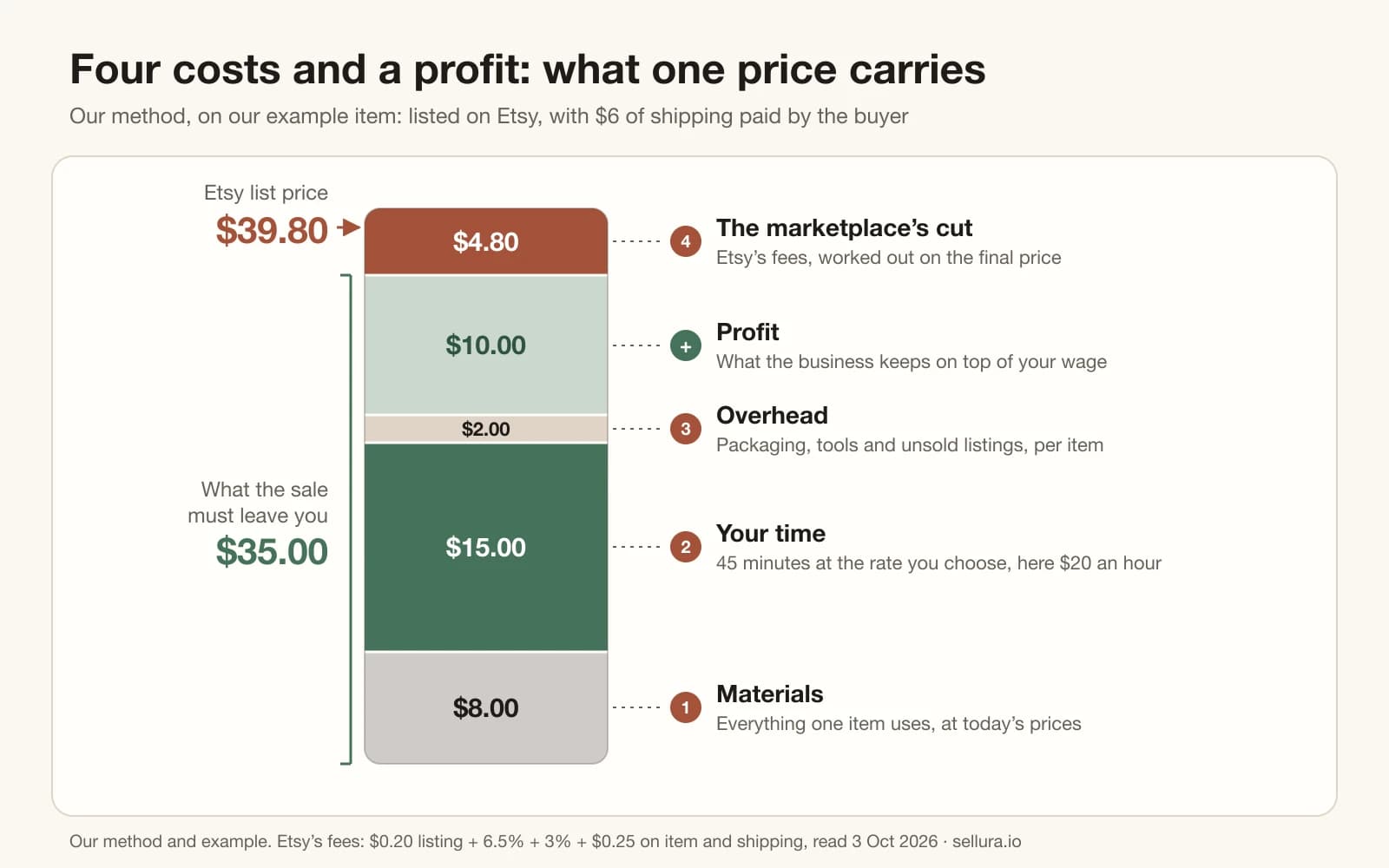
| Line | What goes in | Our example |
|---|---|---|
| Materials | What goes inEverything one item uses, at today's prices | Our example$8.00 |
| Your time | What goes inMinutes per item × your hourly rate | Our example$15.00 (45 min at $20) |
| Overhead | What goes inPackaging, tools and unsold listings, per item | Our example$2.00 |
| Profit | What goes inWhat the business keeps on top of your wage | Our example$10.00 |
| What a sale must leave you | What goes inThe four lines above | Our example$35.00 |
| Etsy's fees at the list price | What goes in$0.20 listing, 6.5% transaction and 3% + $0.25 processing, on the item plus $6 shipping | Our example$4.80 |
| Etsy list price | What goes inThe lowest price that still leaves $35.00 | Our example$39.80 |
Our method and our example. Etsy's rates from its Fees & Payments Policy and Etsy Payments Policy, read 3 October 2026, for a US shop with $6 of shipping paid by the buyer and no Offsite Ads. The calculator in section 6 lands on the same $39.80.
Sources: Etsy Seller Handbook: Pricing Basics (the top-down approach), checked 3 October 2026 · Etsy Fees & Payments Policy (listing fee $0.20, transaction fee 6.5% of item plus delivery), checked 3 October 2026 · Etsy Payments Policy (US processing 3% + $0.25 on the gross order), checked 3 October 2026
Materials: what one item really uses
Count every material in one finished item, not only the main one: the clasp and jump rings as well as the beads, the wick and the label as well as the wax.
Price them at what they would cost to buy again today. That is our rule, and Etsy's Seller Handbook makes the matching point: when material costs rise, you may need to raise your base price to keep your margin.
List every component
Follow one item from start to finish and write down everything it uses, down to the thread, the glue and the tag.
Divide bulk buys by what they really make
A $24 spool that makes 12 pieces costs $2 a piece. If offcuts and failures leave 10 you can sell, each one costs $2.40.
Add the postage on your supplies
Shipping on a supply order is part of what those materials cost, so spread it over what the order makes.
Source: Etsy Seller Handbook: Pricing Basics (materials per item, rising costs), checked 3 October 2026
Your time: choosing an hourly rate
Time is the cost most easily left out, and in our example it is the biggest one: $15 of the $25. Slow work such as crochet or embroidery tips it further. Measure it instead of guessing: time a batch of five from the first cut to the packed parcel and divide by five, then add a share of the work you do once per design, such as photographing it and writing the listing.
The rate is yours to choose. None of the marketplace guides we read sets one, and we don't either. Etsy's Seller Handbook asks what you should pay yourself for everything you do, from packing to editing photos and answering emails, and one shop owner it quotes starts from what a typical day job would pay. Whatever you pick, look at what it does to the price:
| Your rate | Your time on the item | What a sale must leave you | Etsy list price |
|---|---|---|---|
| $15 an hour | Your time on the item$11.25 | What a sale must leave you$31.25 | Etsy list price$35.66 |
| $20 an hour | Your time on the item$15.00 | What a sale must leave you$35.00 | Etsy list price$39.80 |
| $25 an hour | Your time on the item$18.75 | What a sale must leave you$38.75 | Etsy list price$43.95 |
| $30 an hour | Your time on the item$22.50 | What a sale must leave you$42.50 | Etsy list price$48.09 |
Our calculation with the calculator on this page: $8 of materials, $2 of overhead, $10 of profit and $6 of shipping paid by the buyer, at Etsy's US rates read 3 October 2026. The four rates are examples, not recommendations.
Sources: Etsy Seller Handbook: Pricing Basics (cover your labor), checked 3 October 2026 · Etsy Fees & Payments Policy (transaction fee 6.5%), checked 3 October 2026 · Etsy Payments Policy (US processing 3% + $0.25), checked 3 October 2026
Overhead: the costs makers forget
Overhead is what the business pays for that no single item uses up. Add up a month of it and divide by the items you sell in a month: $60 over 30 sales is our example's $2 an item. Etsy's Seller Handbook does the same sum over a year, dividing by the items you plan to make.
Some marketplace costs belong here too, because they are not charged on the sale itself. These are the lines that are easy to miss:
- Packaging: boxes, mailers, tissue, tape, labels and the card in the parcel.
- Tools and equipment: divide what each one cost by the number of items you expect to make with it.
- Listings that haven't sold: Etsy charges $0.20 per listing and renews it every four months at $0.20 unless you switch auto-renew off. The $0.20 on the listing that sells is already in the calculator.
- eBay insertion fees: up to 250 listings a month are free, then $0.35 each.
- Subscriptions and ads: Etsy Plus is $10 a month, an Etsy Ads budget is whatever you set, and a Shopify store has a monthly plan.
- Free shipping: the label becomes your cost, which Etsy's handbook counts with materials or overhead. Set the calculator's shipping to $0 and add the label to overhead: our example then lands on $45.80 on Etsy, the same total as $39.80 plus $6 shipping.
Check what Etsy takes from your own price →
Sources: Etsy Fees & Payments Policy (listing fee, four-month renewals, Etsy Plus $10 a month), checked 3 October 2026 · eBay selling fees (250 listings a month free, then $0.35), checked 3 October 2026 · Etsy Seller Handbook: Pricing Basics (overhead per item, free delivery as a cost), checked 3 October 2026
Profit is not the same as wages
Your hourly rate pays you for the work. Profit is what the business keeps after paying you: it covers a slow month, a refund, a new tool or a sale. Without it, every order pays your wage and leaves the business nothing to absorb anything with.
In our example, the $10 of profit is what soaks up the costs that only some orders carry. Here is what is left of it at the $39.80 Etsy price:
- A 10%-off sale: the item sells for $35.82 and you keep $31.40, so $6.40 of the $10 survives.
- A 20%-off sale: $31.84, Etsy's fees fall to $4.05 and you keep $27.79. That covers the $25 of costs with $2.79 of profit.
- An order Etsy charges Offsite Ads on, at the standard 15%: the fees rise to $11.67 and you keep $28.13, so $3.13 of profit.
- The same order at 12%, the rate once a shop has made $10,000 or more in sales over 365 days: you keep $29.50.
Sources: Etsy Fees & Payments Policy (Offsite Ads 15%, or 12% from $10,000 in sales), checked 3 October 2026 · Etsy Seller Handbook: Pricing Basics (sale prices must start from a true price), checked 3 October 2026
Add the marketplace's cut, the right way round
Every marketplace's fee is mostly a percentage of the order, item and shipping together, so it is charged on the very price you are trying to set. That is why adding a percentage to your costs comes up short: $35 plus 10% is $38.50, and Etsy's fees on that, with $6 of shipping, leave you $33.82, not $35.
This pricing calculator works the other way round, from what a sale must leave you to the lowest list price that leaves it, to the cent, on every marketplace at once. It opens on our example. Type your own numbers, and pick a marketplace to see what its price is made of.
Price your own item
One item costs you $25.00 (materials $8.00 + time $15.00 + overhead $2.00). With $10.00 profit, every sale has to leave $35.00 after fees.
| Marketplace | List at | Fees | Take rate |
|---|---|---|---|
| Not a marketplace: card processing only, US Basic plan — the monthly plan is not in this row. | $36.53 | $1.53 | 3.6% |
| US seller, listing not boosted (a boosted sale adds 12%). | $36.86 | $1.86 | 4.3% |
| US seller, no Offsite Ads on this order (an Offsite order adds 15%). | $39.80 | $4.80 | 10.5% |
| The “most categories” rate, no store subscription, payment processing included. | $41.92 | $6.92 | 14.4% |
| Approved Handmade seller, so the monthly Professional fee is waived. | $42.23 | $7.23 | 15.0% |
| The “Everything Else” category row; the other 35 rows charge differently. | $42.23 | $7.23 | 15.0% |
- Materials $8.00
- Your time $15.00
- Overhead $2.00
- Profit $10.00
- Etsy fees $4.80
Our formula: your costs plus your profit, then the list price that leaves exactly that after each marketplace's published fees on item + shipping. Shipping is treated as a pass-through (the label costs what the buyer pays). Rates checked: Etsy 2026-10-03, Amazon Handmade 2026-10-03, eBay 2026-10-03, Shopify 2026-08-27, Depop 2026-10-03, Walmart 2026-10-03.
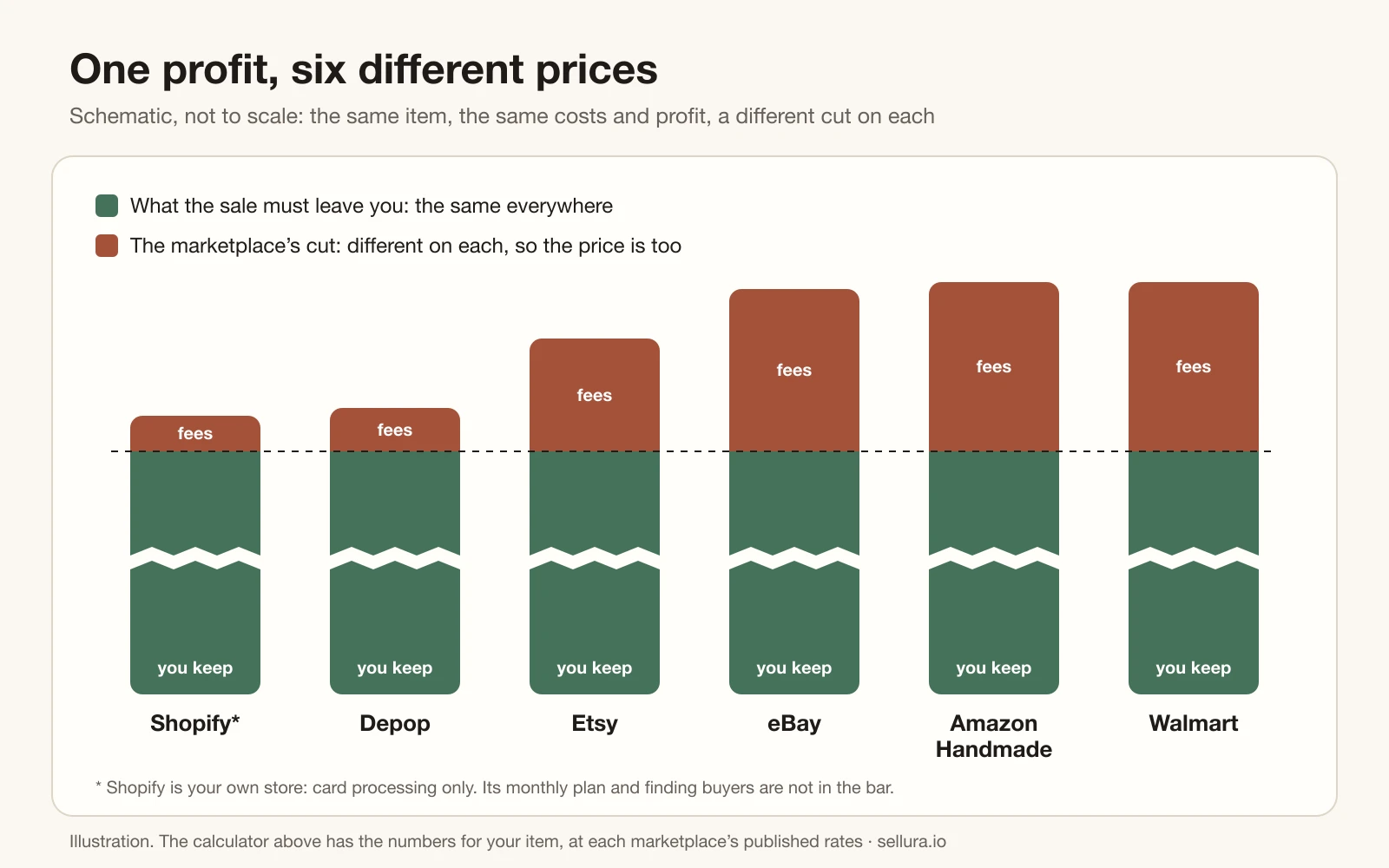
- Etsy: $0.20 per listing, 6.5% of the item and shipping, and 3% + $0.25 processing in the US. Offsite Ads only if you tick the box.
- eBay: 13.6% of the total in most categories (15% for jewelry), plus $0.40 an order over $10. Payment processing is included.
- Depop: no selling fee for US sellers, only 3.3% + $0.45 processing. Boosted listings are not in the row.
- Amazon Handmade: 15% of the total or $0.30 an item, whichever is greater. The monthly plan is waived for approved Handmade sellers.
- Walmart: its Everything Else rate, 15% of the total. Other categories charge differently, jewelry 20% of the first $250.
- Shopify: card processing only, 2.9% + 30¢ on the US Basic plan. Its monthly plan is overhead, and you bring the buyers.
Already have a price? See what each marketplace takes from it →
Sources: Etsy Fees & Payments Policy, checked 3 October 2026 · Etsy Payments Policy (processing rates), checked 3 October 2026 · eBay selling fees (most categories, Jewelry & Watches, per-order fee), checked 3 October 2026 · Depop Help Centre: Seller fees and charges, checked 3 October 2026 · Amazon Handmade: Referral fees (15% or $0.30, plan fee waived), checked 3 October 2026 · Walmart Marketplace pricing (referral fees by category), checked 3 October 2026 · Shopify pricing (US Basic plan card rate), checked 27 August 2026
Sanity-check the price against the market
Your costs give you a floor: the lowest price that still pays you. What buyers will pay is the other half, and Etsy, eBay and Depop each document a way to look it up before you list. Compare with what similar items sold for, not what they are listed at.
If the market sits below your floor, don't price under it: change the item, the time it takes or where you sell it. If the market sits above, you have room to charge more. Etsy's Seller Handbook calls this meeting in the middle.
- eBay: in Advanced Search, choose Completed listings to see what items like yours sold for. For some items the listing form also suggests a price range, based on similar items recently sold.
- Depop: the listing form may suggest a price range and show similar items that sold, sometimes as three strategies from Likely to sell to Less likely. It matches on brand, condition and category as sellers tagged them, so check the matches are really like yours.
- Etsy: its Seller Handbook suggests researching what similar items sell for, on Etsy and elsewhere online. Its listing form also has an earnings calculator: enter a price and your costs to see Etsy's fees and your estimated earnings, Offsite Ads not included.
- Offers: Etsy lets you accept price offers on selected listings, and eBay has Best Offer. The offers you get show you where buyers' prices are.
Sources: eBay Help: Pricing your items (completed listings, price recommendations), checked 3 October 2026 · Depop Help Centre: How to price your item, checked 3 October 2026 · Etsy Seller Handbook: Pricing Basics (research the market, meeting in the middle, offers), checked 3 October 2026 · Etsy Seller Handbook: the earnings calculator in the listing form, checked 3 October 2026
What Sellura does here, and what it doesn't
Sellura doesn't set your price, and it has no sales data to tell you what buyers will pay. The price is yours. What it does is the work around it: the calculator on this page and the fee calculators are free, and once you describe a product it writes the listing for Etsy, eBay, Amazon Handmade, Shopify, Depop and Walmart, each to that marketplace's own limits. Each listing gets a 0–100 score that is deterministic: the same listing always gets the same number, every point traces to a weighted factor, and each weak factor comes with one concrete fix.
The score and the title preview are free on every generation (15 before we ask you to make an account, and never a card). The Listing Grader is free to try, with 2 free checks. A credit unlocks one finished listing: Starter is $15 a month for 25 credits or $150 a year, and Pro is $24 a month for 65 credits plus bulk, or $240 a year. Sellura has no research database, no rank tracking and no ads analysis.
Describe one product, see each marketplace's title and score free → · Plans and credits →
FAQ
How do you price handmade items?
Our method: add materials, your time at an hourly rate you choose and a share of overhead, then the profit you want. That total is what each sale must leave you, so find the list price that leaves it after the marketplace's fees. In our example, $25 of costs and $10 of profit need $39.80 on Etsy, with $6 of shipping paid by the buyer.
What is a good formula for pricing crafts?
Ours: materials + time + overhead + profit = what a sale must leave you, then the lowest list price that leaves it after fees. It is our method, not an official rule, though Etsy's Seller Handbook describes the same cost-first approach. The last step is the one to get right: fees are a percentage of the price, so solve for them instead of adding them on.
How much should I charge per hour for handmade items?
None of the marketplace guides we read sets a rate, and we don't recommend one: it is your wage. Pick what you would accept for the same hours of other work, time a batch to get the minutes per item, and see what the rate does to the price. On a 45-minute item, every extra $5 an hour adds $3.75 to your costs and $4.14 to $4.15 to the Etsy price.
Should I include Etsy fees in my price?
Yes. In the US, Etsy charges $0.20 per listing, 6.5% of the item price plus shipping, and 3% + $0.25 for processing (read 3 October 2026), so on a $40 item with $6 of shipping it takes $4.82. Because the fees grow with the price, find the price that leaves what you need after them rather than adding a fixed amount.
How do I price handmade jewelry?
With the same formula, pricing the metal and stones at what it would cost to replace them today. Fees can differ by category: eBay charges 15% on jewelry instead of 13.6%, and Walmart 20% of the first $250 instead of 15%, so on a $40 item with $6 of shipping Walmart takes $9.20 rather than $6.90. Etsy and Amazon Handmade charge jewelry the same as everything else.
Should I charge for shipping or offer free shipping?
On Etsy it makes no difference to the fees, because Etsy charges them on the item and the shipping together. Our example is $39.80 plus $6 of shipping, or $45.80 with free shipping, and Etsy takes $4.80 either way. With free shipping, count the label as a cost and price it in.
This week: time one batch, add up a month of overhead, and put your numbers into the calculator above: materials, minutes, hourly rate, overhead and profit. Take the price it gives for your marketplace and compare it with what similar items actually sold for. If the market is lower, change the item or where you sell it, not your wage. Then check any price in the free fee calculator, and describe the product to read each marketplace's title preview and score free before you spend a credit.